
AI Tax Controversy Validation Agent
Automating Tax Controversy Document Validation with AI
Streamline IDR tracking and response management
The agent tracks each Form 4564 IDR from issuance through response, monitoring agreed due dates, flagging delinquent requests, and verifying enforcement steps—Delinquency Notice, Pre-Summons Letter, Summons—follow IRM-mandated timelines.
Validate Adjustment Package Consistency
Automated workflows audit the one-to-one tie-out between workpapers, Form 5701 NOPAs, Form 886-A Explanations of Items, and the final RAR—catching dollar mismatches, missing Issue Manager signatures, and incomplete taxpayer position sections before they create Appeals risk.
Monitor Statute Controls and Penalty Approvals
The system continuously tracks ASED buffers, flags cases approaching short-statute thresholds requiring Letter 5153, and verifies IRC 6751(b) written supervisory approval was obtained before any penalty communication—protecting assessment and reducing taxpayer leverage.
How Cassidy automates using AI
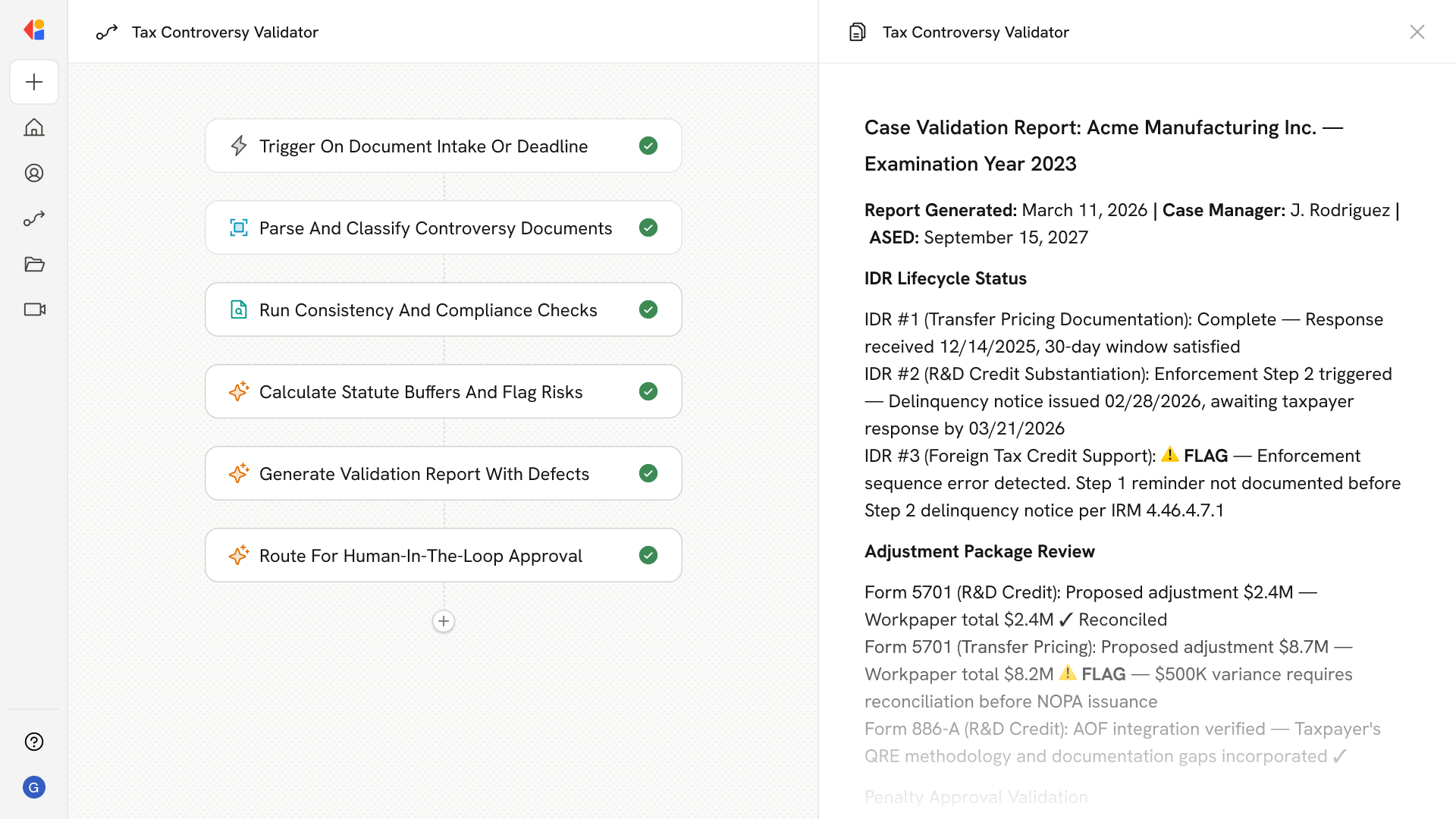
Step 1: Trigger on document intake or deadline event
The Workflow activates when new IDRs, NOPAs, or taxpayer responses enter the system, or when statute deadlines approach—pulling case data from connected document repositories and tracking systems.
Step 2: Parse and classify controversy documents
Cassidy's Agents extract key fields from Forms 4564, 5701, and 886-A using your Knowledge Base of IRM requirements, identifying issue statements, agreed dates, adjustment amounts, and penalty positions.
Step 3: Run consistency and compliance checks
The Workflow cross-references workpaper figures against NOPA amounts and RAR totals, verifies AOF integration of taxpayer facts, confirms 6751(b) approval timing against penalty communications, and validates IDR enforcement step sequencing.
Step 4: Calculate statute buffers and flag risks
Cassidy computes remaining ASED time against case milestones, identifies cases requiring consent extensions or short-statute letters, and applies regime-specific lead times for TEFRA, BBA, and Joint Committee years.
Step 5: Generate validation report with flagged defects
The Agent produces a structured audit output—IDR lifecycle status, adjustment package discrepancies, penalty approval gaps, and Appeals readiness scores—with specific citations to IRM sections and recommended remediation steps.
Step 6: Route for review with Human-in-the-Loop approval
Critical findings requiring judgment—such as potential 6751(b) violations or statute jeopardy—are routed to the appropriate Issue Manager or Case Manager for review before any case action proceeds.
Implement it inside your company
- Hands-on onboarding and support
- Self-paced training for your team
- Dedicated implementation experts
- Ongoing use case discovery
- ROI tracking & analytics dashboards
- Proven playbooks to get started fast