
AI Claims Coverage Determination Agent Agent
Automating Claims Coverage Determination with AI
Context-aware policy analysis
The Agent ingests your full policy stack—declarations, insuring agreements, exclusions, conditions, and endorsements—and normalizes them against the relevant policy period and jurisdiction.
Fact-to-coverage mapping
Automated extraction aligns claim facts and allegations to coverage triggers, identifies factual gaps, and generates targeted questions grounded in policy language.
Audit-ready compliance and governance
Every coverage position includes verbatim policy citations, authority checks, and jurisdiction-specific timing compliance—creating a defensible record from determination through letter delivery.
How Cassidy automates Claims Coverage Determination using AI
Step 1: Trigger on new claim or tender
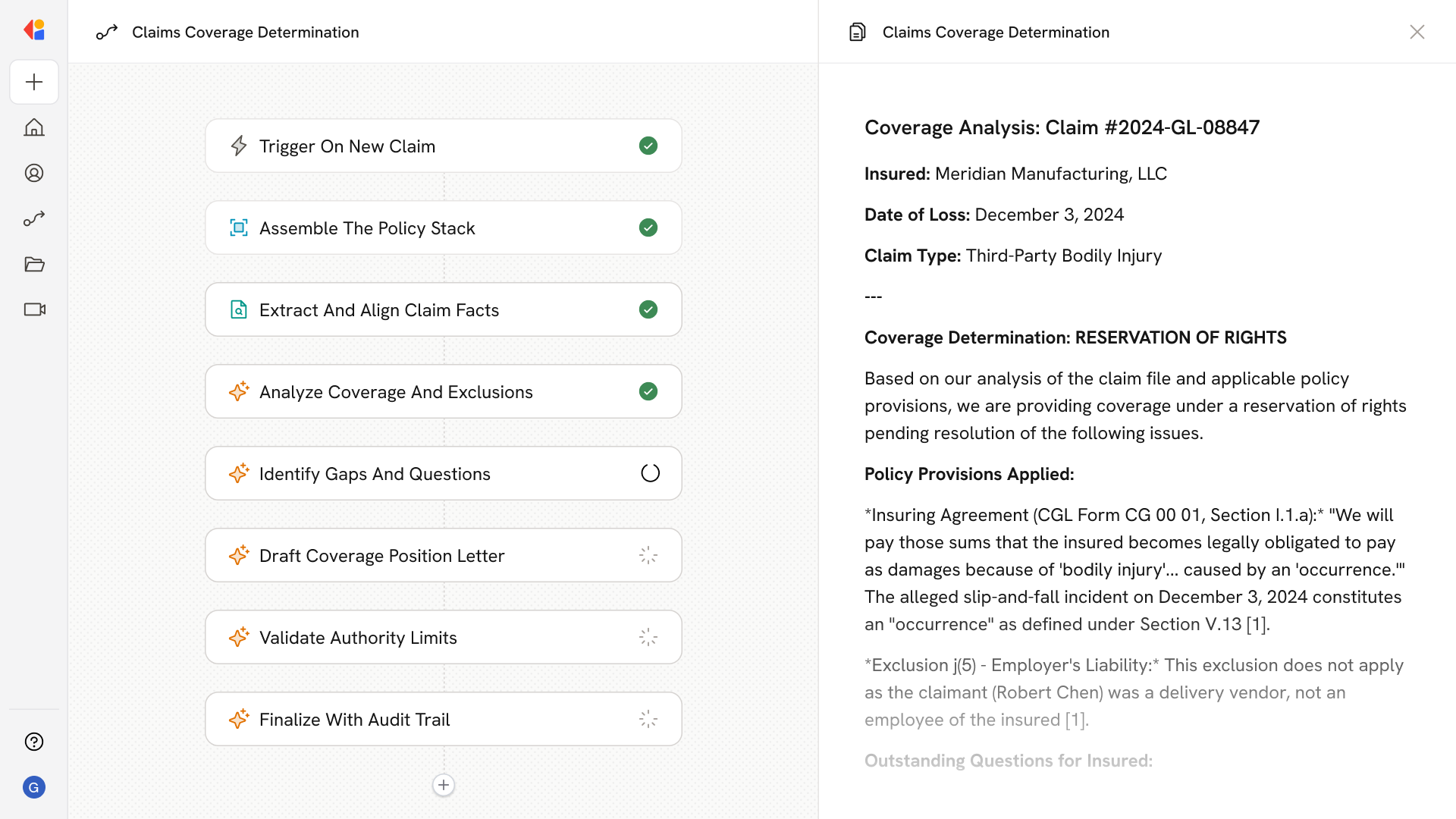
The Workflow activates when a new FNOL, lawsuit tender, or coverage request enters your claims system—pulling in the claim file, complaint, and initial facts.
Step 2: Assemble and normalize the policy stack
Cassidy retrieves the full policy stack from your Knowledge Base—declarations, insuring agreements, definitions, exclusions, conditions, and endorsements—and aligns them to the correct policy period, insureds, and jurisdiction.
Step 3: Extract and align claim facts
The Agent parses allegations and claim details, builds a timeline, and maps facts to coverage triggers: bodily injury, property damage, occurrence, covered perils, or wrongful acts depending on the policy type.
Step 4: Analyze coverage triggers and exclusions
Cassidy applies agentic reasoning to evaluate whether facts satisfy insuring grants, then works through exclusions, conditions precedent, and endorsements—citing verbatim policy language throughout.
Step 5: Identify factual gaps and generate questions
Where information is missing, the Agent produces targeted questions for the insured or broker—referencing the cooperation clause and specifying exactly what's needed to complete the analysis.
Step 6: Draft the coverage position letter
Cassidy generates a Reservation of Rights, Coverage Position, or Denial letter with a factual summary, quoted policy provisions, jurisdiction-specific language, and defense management terms where duty to defend applies.
Step 7: Validate authority and route for approval
The Workflow checks whether the recommended position falls within adjuster authority limits. If thresholds are exceeded, it routes automatically to a supervisor or coverage counsel for review.
Step 8: Finalize with audit trail and compliance tracking
Cassidy logs the complete decision rationale, timestamps, and citations, tracks regulatory acknowledgment windows, and stores static records—ensuring every determination is defensible and audit-ready.
Implement it inside your company
- Hands-on onboarding and support
- Self-paced training for your team
- Dedicated implementation experts
- Ongoing use case discovery
- ROI tracking & analytics dashboards
- Proven playbooks to get started fast