AI Operating Room Scheduling Agent
Automating OR Scheduling with AI
Predict case durations with precision
AI models analyze procedure codes, surgeon history, patient factors, and equipment needs to forecast accurate case times with confidence intervals—eliminating the guesswork that causes cascading delays and overtime.
Surface hidden capacity and optimize block utilization
The system continuously monitors block allocations, identifies underutilized time before release windows, and recommends best-fit case placements that maximize prime-time utilization while respecting room, staff, and equipment constraints.
Coordinate day-of adjustments in real time
As cases finish early or late, the agent reecasts the remaining schedule, suggests resequencing opportunities, and alerts teams to predicted delays, equipment conflicts, or downstream bed constraints.
How Cassidy automates this using AI
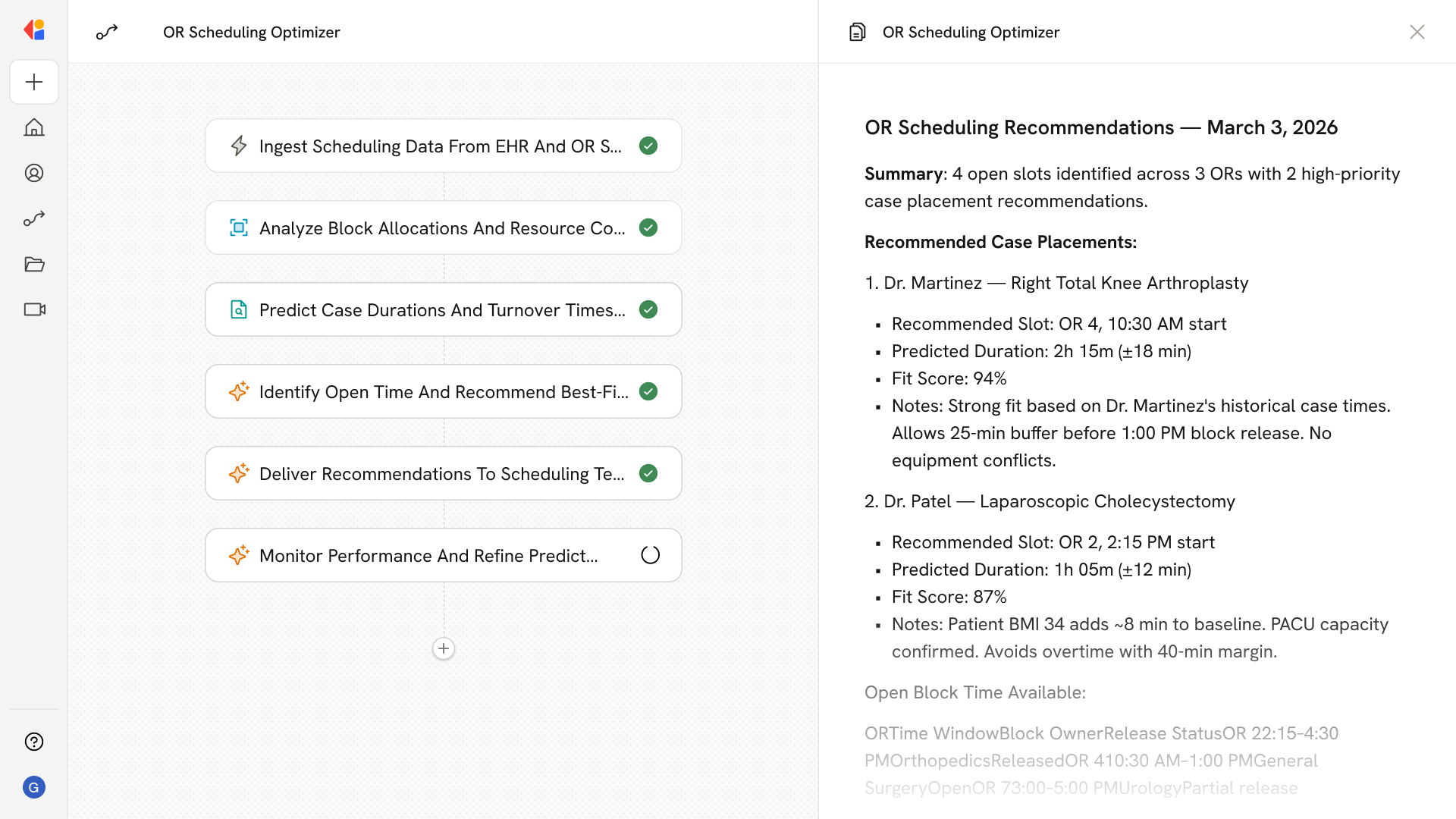
Step 1: Ingest scheduling data from your EHR and OR systems
The Workflow connects to your EHR and OR management systems to pull scheduled cases, procedure codes, surgeon identifiers, patient attributes, room assignments, equipment requirements, and historical case timestamps.
Step 2: Analyze block allocations and resource constraints
Cassidy maps your block ownership rules, release policies, staff rosters, equipment availability, and downstream capacity (PACU/ICU beds) to understand the full constraint landscape for scheduling decisions.
Step 3: Predict case durations and turnover times
Using your historical data, Cassidy generates predicted case durations with uncertainty bounds for each procedure-surgeon combination, accounting for anesthesia type, patient complexity, and time-of-day effects.
Step 4: Identify open time and recommend best-fit slots
The Workflow surfaces available block time, calculates utilization gaps, and recommends optimal case placements that balance prime-time targets, overtime avoidance, and resource conflicts—complete with fit scores and conflict warnings.
Step 5: Deliver recommendations to your scheduling team
Cassidy sends slot recommendations, predicted start/finish times, and constraint alerts directly to your schedulers via your existing tools—whether that's your OR scheduling system, Teams, Slack, or email.
Step 6: Monitor performance and refine predictions
Retrospective analytics compare forecasted vs. actual durations, track utilization and late starts, and feed continuous model improvement to increase accuracy over time.
Implement it inside your company
- Hands-on onboarding and support
- Self-paced training for your team
- Dedicated implementation experts
- Ongoing use case discovery
- ROI tracking & analytics dashboards
- Proven playbooks to get started fast