
AI SCADA Alert Triage Agent
Automating SCADA Alert Triage with AI
Detect Alarm Floods and Surface Root Causes First
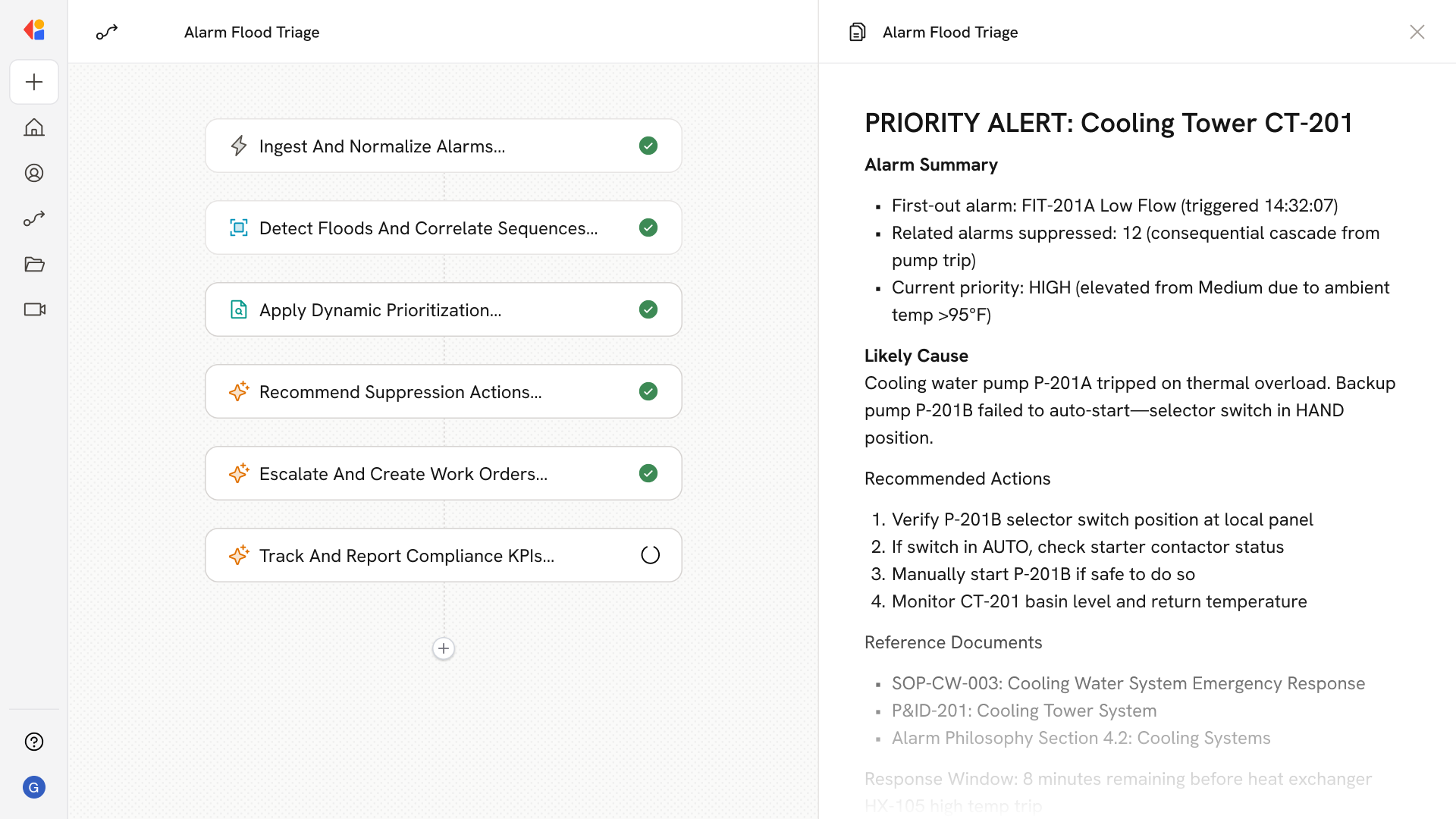
The agent correlates incoming alarms in real time, identifies probable first-out events, and groups consequential alerts by equipment and process unit—so operators see what matters, not noise.
Prioritize by Risk with Full Context
Every alarm is dynamically scored against your Alarm Philosophy Document using severity, time-to-respond, and current operating mode—delivering a prioritized, actionable list that respects your governance framework.
Guide Operators with Clear Next Steps
Each surfaced alarm includes the likely cause, recommended response procedure, SOP links, and time-to-respond countdown—keeping humans in the loop with explainable, auditable recommendations.
How Cassidy automates alarm management using AI
Step 1: Ingest alarms and normalize context
The Workflow triggers on new alarms from your SCADA, DCS, or historian via OPC UA, MQTT, or direct integration. Cassidy normalizes tag names and maps each alarm to your asset hierarchy, equipment, and current operating mode.
Step 2: Detect floods and correlate sequences
Cassidy analyzes alarm timing and topology to flag flood conditions, identify probable first-out alarms, and cluster related alerts by equipment or process unit—filtering chatter and duplicates automatically.
Step 3: Apply dynamic prioritization
Using your Alarm Philosophy Document and risk matrix stored in the Knowledge Base, Cassidy assigns context-aware priority based on consequence severity, time-to-respond, and operating state—surfacing the minimum actionable set.
Step 4: Recommend suppression and grouping
For consequential alarms following a root cause, Cassidy recommends dynamic suppression or grouping per your shelving and state-based alarming policies—reducing operator overload while maintaining full traceability.
Step 5: Deliver guidance with Human-in-the-Loop approval
Cassidy presents operators with the prioritized alarm, likely cause hypothesis, recommended action steps, and links to SOPs or P&IDs. Operators accept, reject, or annotate recommendations—capturing feedback for governed model improvement.
Step 6: Escalate and integrate
If response deadlines are exceeded or severity warrants, Cassidy automatically creates CMMS work orders, routes tickets, or triggers callout escalations—ensuring nothing slips through.
Step 7: Measure and report KPIs
Cassidy continuously tracks EEMUA 191/ISA-18.2 metrics—alarms per 10 minutes, flood frequency, bad actors, priority distribution, and response times—generating dashboards and audit-ready reports for lifecycle compliance.
Implement it inside your company
- Hands-on onboarding and support
- Self-paced training for your team
- Dedicated implementation experts
- Ongoing use case discovery
- ROI tracking & analytics dashboards
- Proven playbooks to get started fast