
AI Research Synthesis Agent
Automating Research Synthesis with AI
Hypothesis-Led Search and Collection
The agent constructs reproducible search strings across academic databases, grey literature, and market sources—logging every query, filter, and result count for PRISMA-S documentation while pulling broker reports, filings, and expert interviews for your consulting fact base.
Structured Screening and Extraction
AI-assisted screening triages thousands of citations against your inclusion/exclusion criteria, resolves conflicts through human-in-the-loop review, and extracts data to predefined schemas with paragraph-level provenance for every claim.
Synthesis and Storyline Generation
The system triangulates academic, market, and expert sources into MECE-structured deliverables—generating exhibit-ready charts with auto-footnoting, PRISMA flow diagrams, and executive storylines anchored in traceable citations.
How Cassidy automates research synthesis using AI
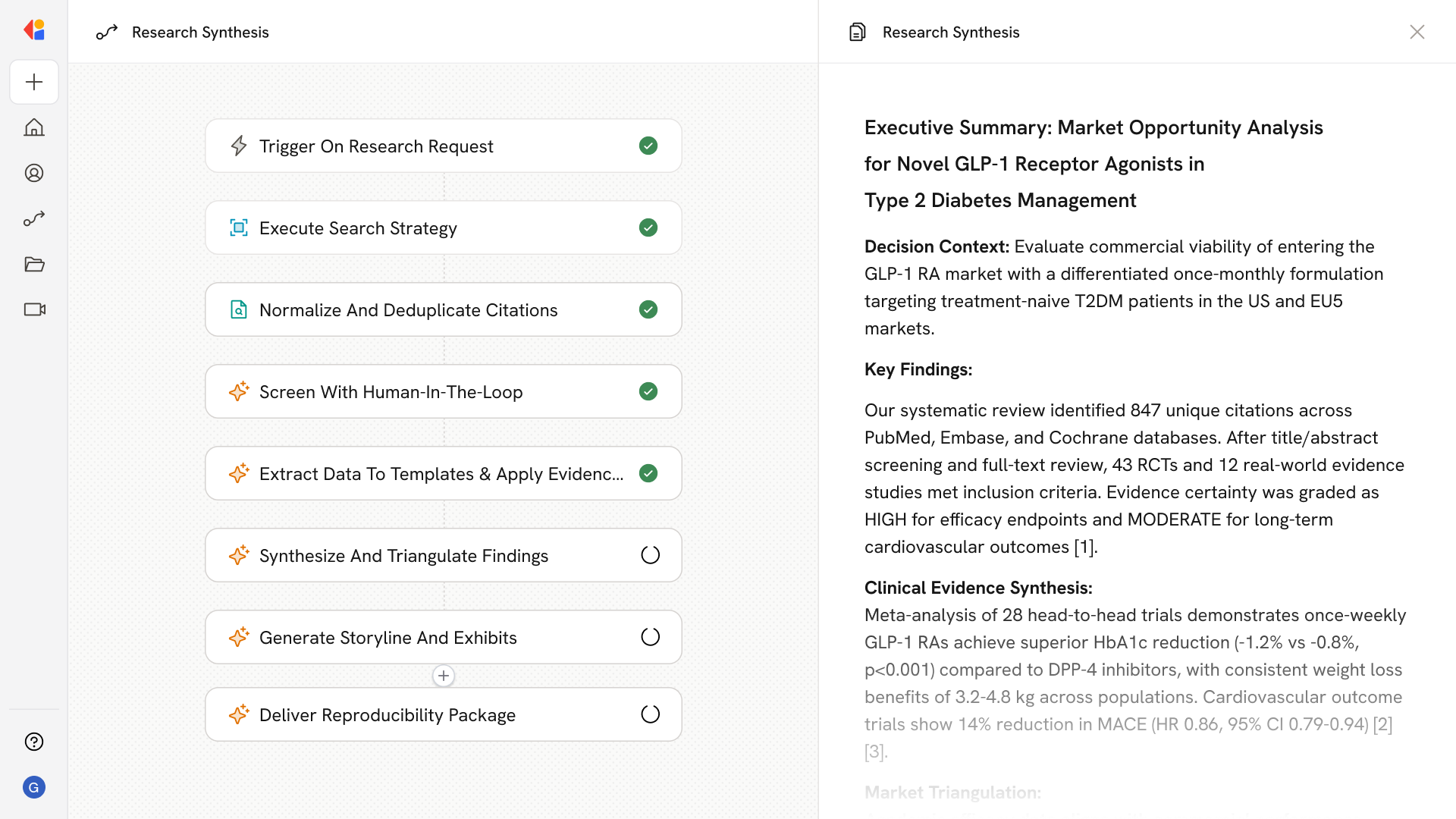
Step 1: Trigger on research request
The Workflow activates when a research manager submits a new synthesis request—capturing the mandate, decision context, PICO/PEO-framed questions, and inclusion/exclusion criteria to establish the issue tree and 80/20 priorities.
Step 2: Execute search strategy and ingest sources
Cassidy runs reproducible searches across configured databases (PubMed, Embase, Scopus), registers, and grey literature sources while simultaneously pulling industry reports, 10-Ks, and earnings calls. All searches are logged with timestamps, queries, and result counts for PRISMA-S compliance.
Step 3: Normalize and deduplicate citations
The Workflow imports citations into the Knowledge Base, standardizes metadata, and applies fuzzy matching to deduplicate across sources—maintaining a source log with IDs, DOIs, and file hashes while capturing pre- and post-dedupe counts.
Step 4: Screen and filter with Human-in-the-Loop
Cassidy's Agents triage titles and abstracts against your criteria, flagging uncertain cases for human review. Full-text screening logs reasons for exclusion at each stage, automatically updating PRISMA counters throughout the process.
Step 5: Extract data to structured schemas
The Workflow extracts study metadata, populations, interventions, outcomes, effect sizes, and market sizing inputs to predefined templates—capturing paragraph-level citations and figure/table IDs with confidence scores for every data point.
Step 6: Apply critical appraisal and evidence grading
Cassidy scaffolds risk-of-bias assessment using RoB 2, ROBINS-I, or CASP templates, requiring source quotes for each judgment. Findings roll up to GRADE certainty ratings with linked rationales stored in the Knowledge Base.
Step 7: Synthesize and triangulate evidence
The Workflow clusters themes, calculates effect sizes where applicable, and triangulates academic findings against market data and expert inputs—reconciling deltas and building clean-sheet models for TAM/SAM/SOM or cohort analyses.
Step 8: Generate storyline and exhibits
Cassidy produces SCQA-structured executive storylines with exhibit-ready charts, auto-generated footnotes and endnotes, and a complete PRISMA 2020 flow diagram—ensuring every claim traces back to a source passage with date and citation ID.
Step 9: QA and deliver reproducibility package
The Workflow runs numeric consistency checks, validates citation coverage, and flags freshness issues before delivering the final deck, evidence tables, annotated bibliography, and a complete audit trail for future updates.
Implement it inside your company
- Hands-on onboarding and support
- Self-paced training for your team
- Dedicated implementation experts
- Ongoing use case discovery
- ROI tracking & analytics dashboards
- Proven playbooks to get started fast