
AI Production Schedule Validation Agent
Automating Production Schedule Validation with AI
Constraint-clean schedules, every time
The agent validates candidate schedules against real resource limits—machine availability, labor skills, tooling, and secondary constraints—so only executable plans reach the shop floor.
End-to-End ATP/CTP Checks
Automated validation runs time-phased material availability (ATP) and capable-to-promise (CTP) calculations across multi-level BOMs, flagging shortages and computing earliest feasible delivery dates before commitment.
Exception Detection with Recommended Repairs
The system identifies constraint violations—late orders, resource overloads, pegging conflicts, sequence issues—and proposes repair actions with clear KPI tradeoffs, so planners focus on decisions rather than data hunting.
How Cassidy automates schedule feasibility validation using AI
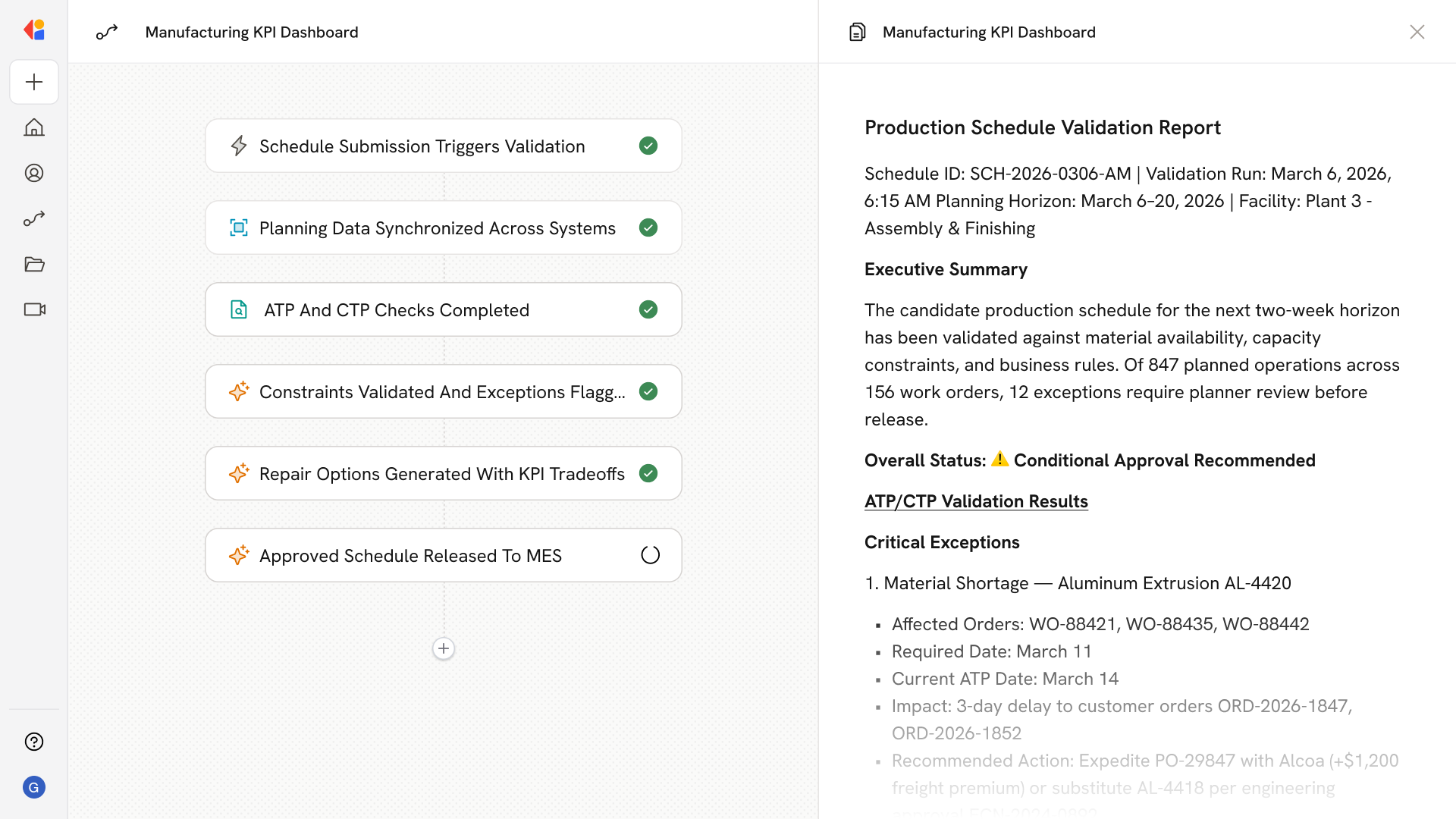
Step 1: Trigger on schedule submission or planning cycle
The Workflow activates when a candidate schedule is submitted from your APS, ERP, or MRP system—or runs on a scheduled cadence to validate the latest planning snapshot before release windows.
Step 2: Collect and synchronize planning data
Cassidy pulls current demand, open orders, BOMs, routings, calendars, capacities, WIP status, inventory levels, maintenance windows, and supplier lead times from your connected systems to build a complete validation model.
Step 3: Run ATP and CTP validation
The Agent performs time-phased ATP checks across all BOM levels to confirm material availability, then executes CTP analysis using routings, capacities, and calendars to verify end-to-end feasibility for each order and operation.
Step 4: Validate constraints and detect exceptions
Cassidy checks the schedule against capacity limits, sequence-dependent setups, campaign rules, time fences, frozen operations, and business policies—flagging violations like resource overloads, late demands, pegging conflicts, and allocation breaches.
Step 5: Generate repair recommendations and scenario comparisons
The Agent applies dispatching heuristics to propose repairs—alternate routings, overtime options, sequence adjustments—and computes KPI impacts (OTD, utilization, setup time) so planners can compare tradeoffs.
Step 6: Route for approval and controlled release
Validated schedules with exception summaries are routed to stakeholders for review. Once approved, Cassidy locks firm operations within the frozen horizon and releases dispatch lists to MES, maintaining a full audit trail of changes and decisions.
Implement it inside your company
- Hands-on onboarding and support
- Self-paced training for your team
- Dedicated implementation experts
- Ongoing use case discovery
- ROI tracking & analytics dashboards
- Proven playbooks to get started fast