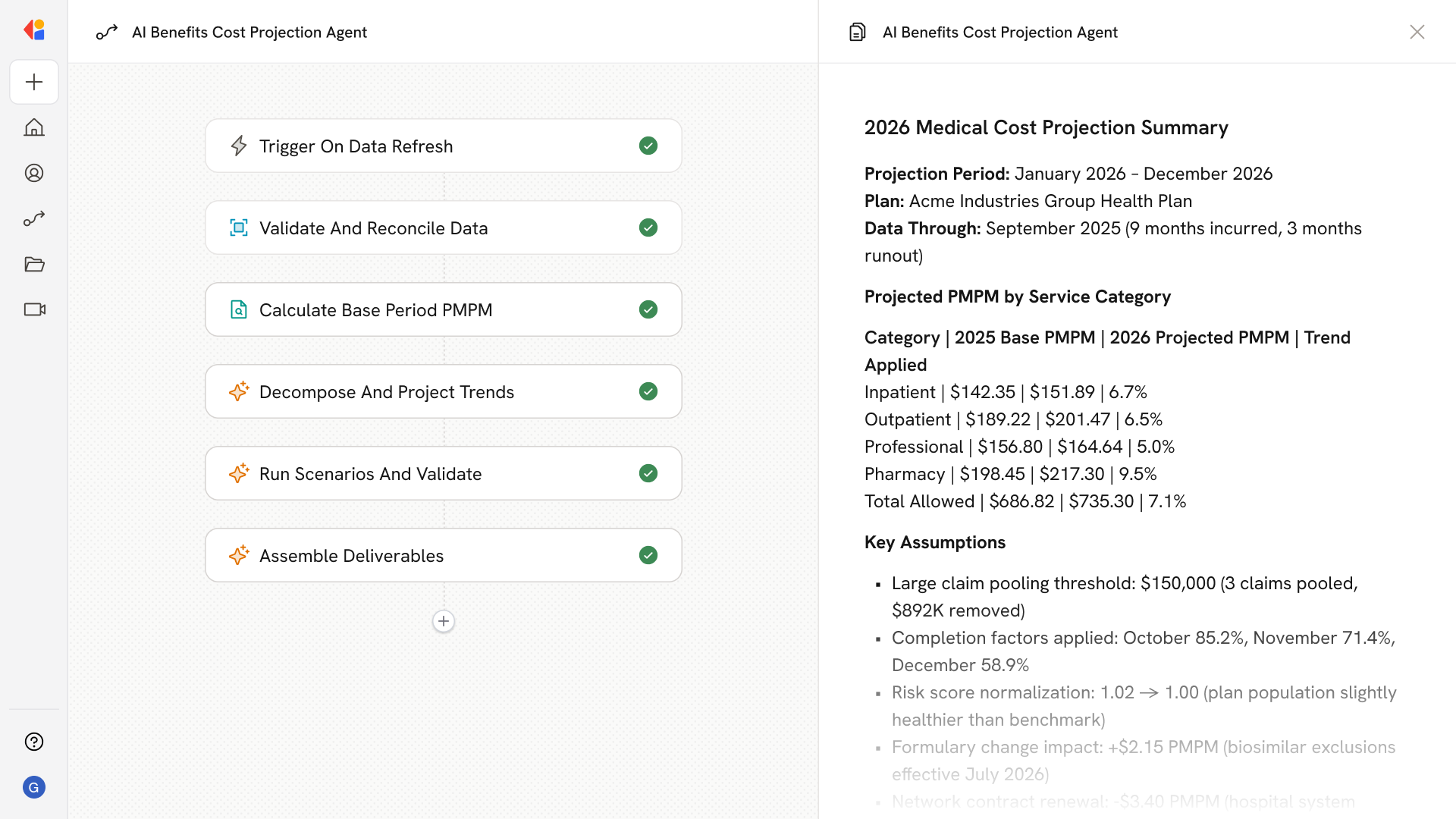

AI Payroll Benefits Deduction Reconciliation Agent
Automating Payroll Deduction Reconciliation for Benefits with AI
Catch Variances Before They Become Premium Leakage
The agent matches carrier invoices against payroll deductions and enrollment data at the member level, flagging discrepancies like enrollments in transit, rate mismatches, and tier errors before you overpay.
Classify and Route Exceptions Automatically
AI-powered rules identify root causes EOI pending, COBRA timing gaps, partial-month proration, or dependent eligibility issues and route each variance to the right team with suggested resolution paths.
Close Faster with Audit-Ready Reconciliation Reports
Automated workflows generate carrier-specific variance reports, GL tie-outs, and payment packages with full documentation, turning a manual spreadsheet exercise into a repeatable, auditable monthly close.
How Cassidy automates this using AI
Step 1: Ingest carrier invoices, payroll, and enrollment data
The Workflow triggers on your monthly billing cycle, pulling carrier invoices (PDF or EDI), payroll deduction exports, and enrollment files from your HRIS into Cassidy's Knowledge Base. Data is normalized, plan codes are mapped, and coverage periods are aligned automatically.
Step 2: Match members and compare premiums
Cassidy matches each billed member to enrollment and payroll records using deterministic rules (employee ID, name, DOB) with configurable tolerances. For every plan, it calculates expected premiums employee deductions plus employer contributions and compares against carrier-billed amounts.
Step 3: Classify variances with exception coding
The Workflow applies your exception taxonomy to categorize each variance: enrollments or terminations in transit, EOI pending, rate or tier mismatches, COBRA discrepancies, timing and proration differences, or rounding. High-dollar and high-risk items are prioritized for review.
Step 4: Route exceptions and suggest resolutions
Cassidy routes each exception to the appropriate queue HR for enrollment corrections, Payroll for true-ups, Finance for carrier credits with recommended actions. It can draft credit request memos, flag items approaching carrier lookback windows, and auto-close variances that net to zero.
Step 5: Generate reconciliation reports and accounting outputs
Once exceptions are resolved, Cassidy produces carrier-specific reconciliation reports, journal entry files for GL posting, and payment instructions (list-bill short-pay or self-bill remittance). Human-in-the-Loop approval ensures sign-off before payment.
Step 6: Track KPIs and surface root causes
The Workflow logs every adjustment and resolution, building dashboards for PEPM recovered, auto-match rates, exception aging, and write-off trends giving your team visibility into recurring issues and opportunities to strengthen upstream data feeds.
Implement it inside your company
- Hands-on onboarding and support
- Self-paced training for your team
- Dedicated implementation experts
- Ongoing use case discovery
- ROI tracking & analytics dashboards
- Proven playbooks to get started fast