
AI Manufacturing Cost Data Reconciliation Agent
Automating Manufacturing Cost Data Reconciliation with AI
Unified Data Acquisition and Normalization
The agent ingests and harmonizes data from ERP, MES, and shop-floor systems—mapping BOMs, routings, standard costs, production orders, and inventory movements into a single, reconciled data model with consistent item IDs, UoM conversions, and cost component structures.
Automated Variance Calculation and Analysis
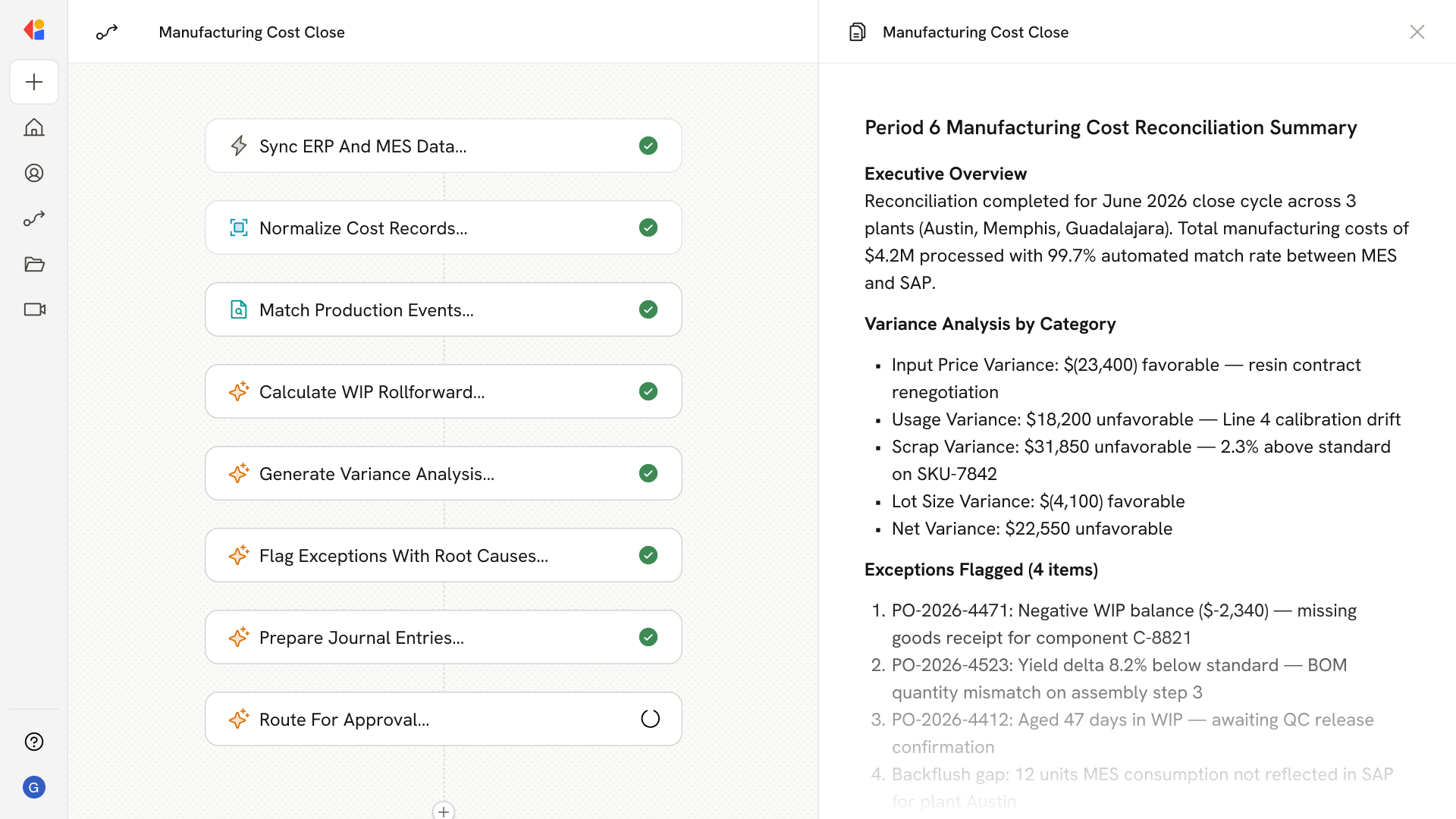
AI-powered engines calculate standard vs. actual manufacturing variances, splitting them into categories like input price (PPV), usage, resource efficiency, scrap, and lot size—then surface root-cause insights at the SKU, order, and plant level.
Period-End Close and Audit Readiness
Automated workflows generate WIP and inventory rollforwards, subledger-to-GL reconciliations, and journal entry proposals—complete with data lineage and exception logs ready for external audit review.
How Cassidy automates period-end close and variance analysis using AI
Step 1: Trigger on close calendar or data sync
The Workflow activates automatically based on your close calendar schedule or when new ERP/MES data syncs—capturing production orders, confirmations, goods movements, and cost postings in real time.
Step 2: Normalize and enrich cost data
Cassidy harmonizes data across systems, mapping plant codes, item IDs, and UoM conversions while attaching standard cost rates and actual purchase costs to each consumption and production event.
Step 3: Match MES events to ERP documents
The agent performs record-level matching between MES production, consumption, and scrap records and ERP goods issues, receipts, and confirmations—flagging backflush gaps, timing differences, and duplicate postings.
Step 4: Calculate WIP and inventory rollforwards
Cassidy computes WIP as Beginning WIP + Manufacturing Costs − COGM, reconciles inventory subledgers (RM, WIP, FG) to GL balances, and isolates reconciling items like timing mismatches or unposted accruals.
Step 5: Generate variance analysis by category
The Workflow calculates total variance and splits it into input price, usage, resource efficiency, scrap, and lot size categories—aligned to your ERP framework—with drill-down by cost component, SKU, and production order.
Step 6: Surface exceptions with root-cause insights
Cassidy flags orders with yield deltas, abnormal scrap, negative WIP, or aged stuck orders, and generates root-cause hints such as BOM misalignment, incorrect backflush pointers, or UoM mismatches.
Step 7: Prepare journal entries and audit pack
The agent drafts journal entry proposals for inventory true-ups, variance allocations, and accruals—then assembles a complete audit pack with data lineage, reconciliations, and exception logs for external review.
Step 8: Human-in-the-Loop approval and posting
Before finalizing, Cassidy routes proposed journals and exception resolutions for review, keeping your team in control of business-critical close decisions while cutting manual reconciliation time from days to hours.
Implement it inside your company
- Hands-on onboarding and support
- Self-paced training for your team
- Dedicated implementation experts
- Ongoing use case discovery
- ROI tracking & analytics dashboards
- Proven playbooks to get started fast