
AI Estimated Tax Notice Agent
Automating Estimated Tax Notice Drafting with AI
Intelligent Notice Triage and Reconciliation
The agent ingests CP30/CP30A notices alongside IRS transcripts and payment records, automatically reconciling prepayments against installment deadlines and flagging misapplied credits or timing mismatches that require correction.
Dual-Path Penalty Computation with Safe Harbor Analysis
AI automation runs both standard and annualized income installment method calculations, testing 90% current-year and 110% prior-year safe harbor thresholds to identify the optimal computation strategy for HNW clients with lumpy income patterns.
Waiver Eligibility Screening and Response Drafting
The system evaluates disaster relief windows, retirement/disability criteria, and computational error pathways, then generates IRS-ready Form 2210 packages and abatement request letters complete with IRM references, transaction code citations, and sworn statement text blocks.
How Cassidy automates using AI
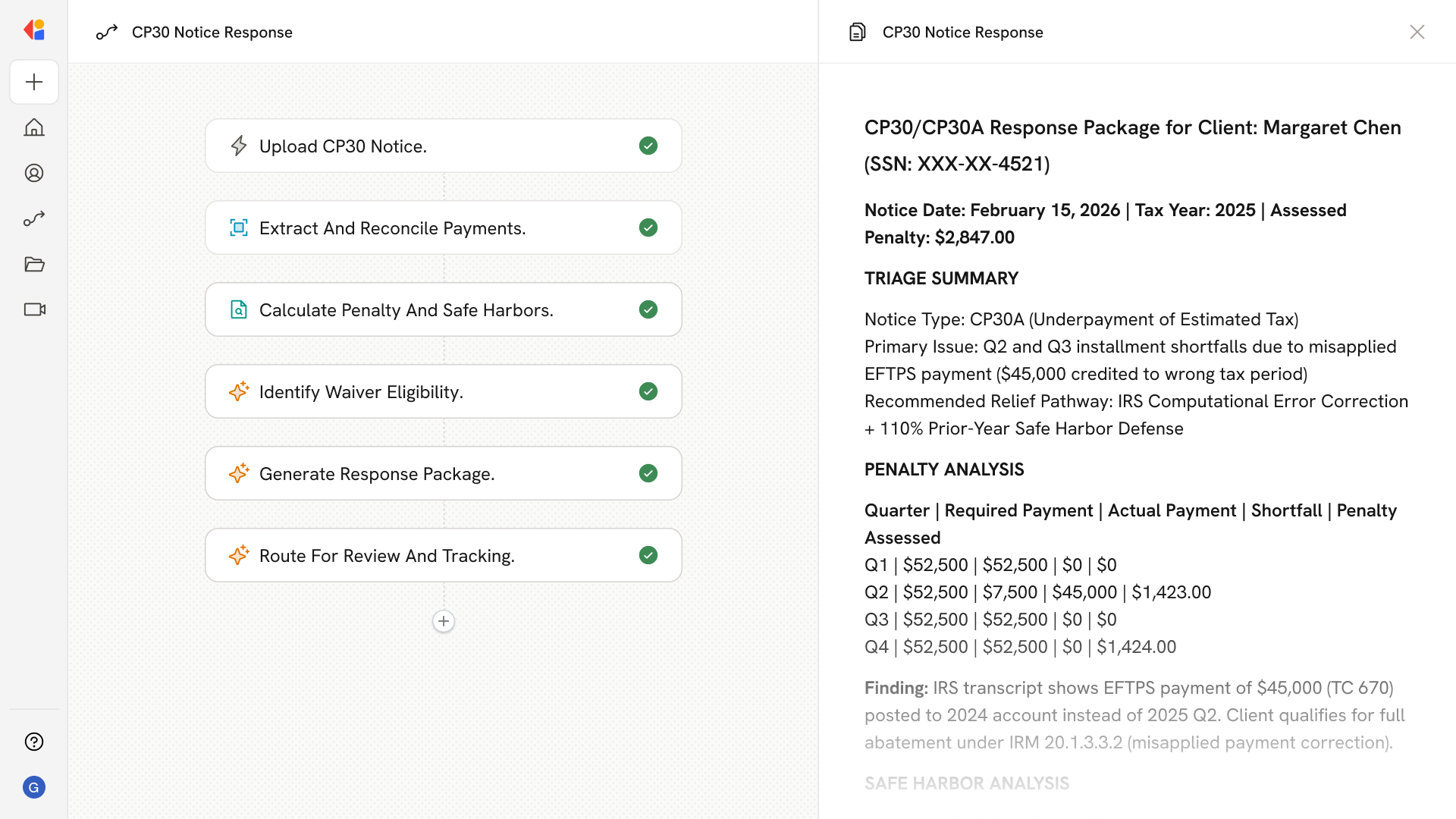
Step 1: Trigger on new notice or document upload
The Workflow activates when a CP30 or CP30A notice is uploaded, received via email, or flagged in your document management system—pulling in the notice PDF, client's filed 1040, and any attached Form 2210.
Step 2: Extract and reconcile payment data
Cassidy parses notice details, retrieves IRS transcript data, and matches all prepayments (withholding, EFTPS, Direct Pay) against installment due dates to identify underpayment segments, misapplied credits, or transcript timing issues.
Step 3: Compute penalty and test safe harbors
The Workflow runs dual-path penalty calculations—standard method and Annualized Income Installment Method via Schedule AI—while testing 90% current-year and 110% prior-year safe harbor thresholds based on the client's AGI and filing status.
Step 4: Screen waiver and abatement pathways
Cassidy evaluates eligibility for disaster relief (checking ZIP codes against federally declared disaster windows), retirement/disability waivers, and IRS computational error corrections, flagging the strongest relief pathway for each case.
Step 5: Draft response package with IRS meta-language
The Workflow generates a complete response package: cover letter citing CP30 facts and IRM 20.1.3 references, Form 2210 with correct elections and Schedule AI, sworn statement text blocks where required, and an exhibit list linking payment proofs and transcript excerpts.
Step 6: Route for review and track resolution
Cassidy sends the draft package for Human-in-the-Loop approval, then creates follow-up tasks for phone advocacy (with PRC and TC reference scripts), monitors transcripts for TC 171/177 abatement entries, and calendars future ES installments to prevent recurrence.
Implement it inside your company
- Hands-on onboarding and support
- Self-paced training for your team
- Dedicated implementation experts
- Ongoing use case discovery
- ROI tracking & analytics dashboards
- Proven playbooks to get started fast