
AI EHS Incident Data Validation Agent
Automating EHS Incident Data Validation with AI
Deduplicate and normalize incident records from any source
The agent uses probabilistic matching and NLP to resolve duplicates across EHS systems, clinic records, HR, and contractor portals—unifying fragmented data into a single, standardized incident master with full traceability.
Auto-classify OSHA recordability with decision-tree logic
Automated workflows apply Part 1904 rules to recommend recordable vs. non-recordable status, assign the most serious outcome (G, H, I, J), and flag privacy cases—routing edge cases to reviewers with confidence scores and supporting evidence.
Generate ITA-ready submissions and audit-proof documentation
The system produces establishment-level 300 Logs, 300A Summaries, and 301 Reports, then validates CSV files against OSHA ITA specs—catching sum-check errors, missing fields, and code mismatches before submission.
How Cassidy automates OSHA recordkeeping using AI
Step 1: Ingest incident data from multiple sources
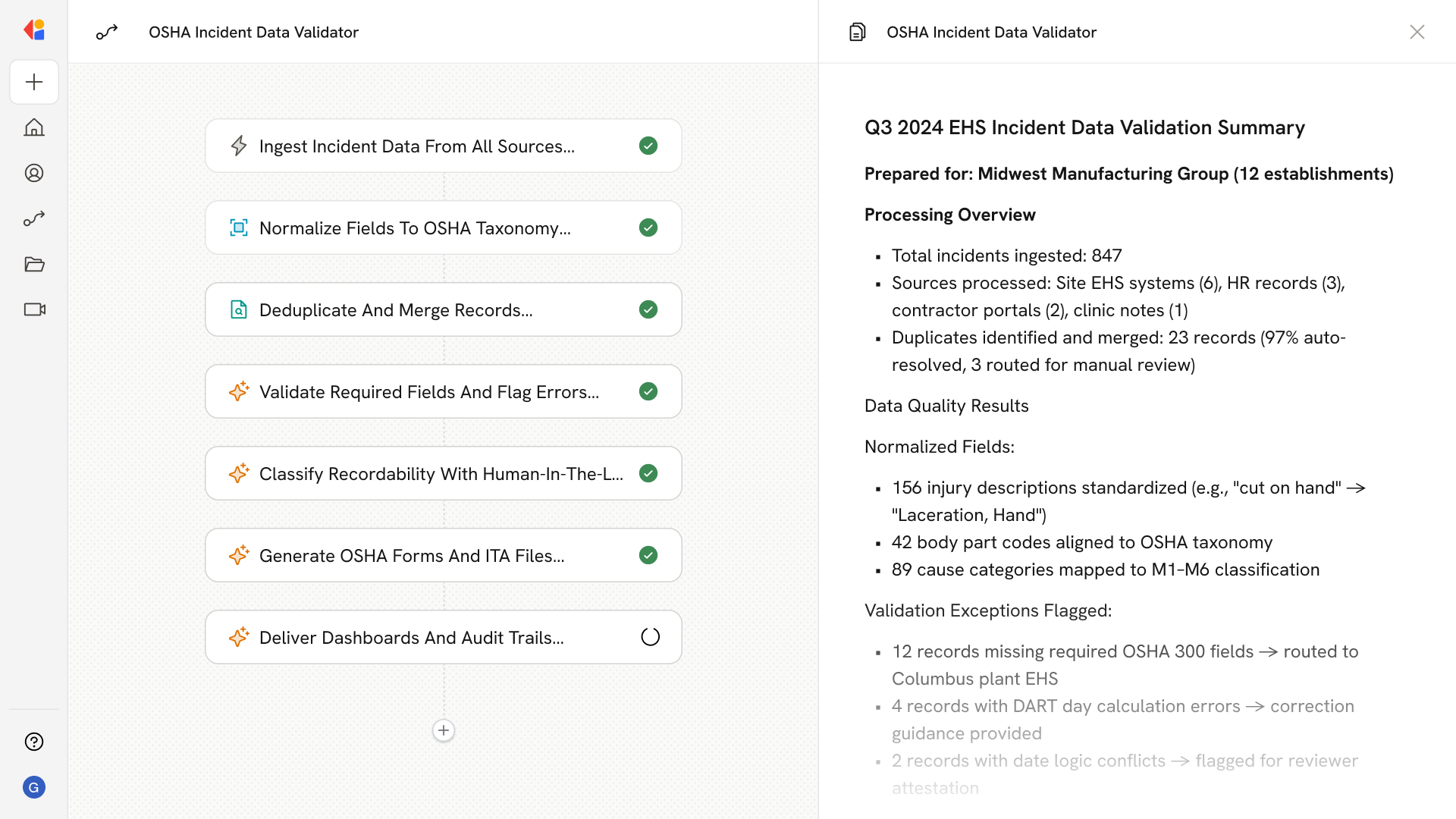
The Workflow triggers on new incident submissions—whether from site EHS systems, shared spreadsheets, clinic notes, HR records, or contractor portals—and anchors each record to the correct establishment using your site master with EIN, NAICS, and address data.
Step 2: Normalize fields and align to corporate taxonomy
Cassidy standardizes date/time formats, person identifiers, location hierarchies, and free-text terms. NLP maps injury descriptions like “cut” to “laceration,” aligns body part codes, and harmonizes cause categories to your controlled vocabularies and OSHA's M1–M6 classification.
Step 3: Deduplicate and resolve entities
The Workflow applies fuzzy matching across sources—comparing person, date, location, equipment, and narrative text—to identify duplicates created in parallel systems. High-confidence matches merge automatically; medium and low-confidence cases route to EHS reviewers with explainable scores.
Step 4: Run data quality checks and flag exceptions
Cassidy validates completeness for required OSHA 300/301 fields, checks date logic and DART day counts, and enforces numerical constraints. Records that fail validation route to site EHS with specific error messages and correction guidance.
Step 5: Auto-classify recordability and outcomes
The Workflow applies OSHA Part 1904 decision logic—evaluating work-relatedness, medical treatment beyond first aid, significant diagnoses, and privacy indicators—to recommend recordable status and the most serious outcome. Human-in-the-Loop approval captures reviewer attestation and logs any overrides.
Step 6: Generate forms and prepare ITA submission files
Cassidy produces establishment-level 300 Logs, 300A Annual Summaries, and 301 Incident Reports with privacy cases handled appropriately. The system then generates ITA-ready CSV files, pre-validates against OSHA specs, and surfaces any errors before electronic submission.
Step 7: Deliver dashboards and maintain audit trails
The Workflow calculates TRIR, DART, LTIR, and severity rates with multi-site rollups, while maintaining immutable logs of every change, merge, classification decision, and submission—ready for OSHA audits or internal reviews.
Implement it inside your company
- Hands-on onboarding and support
- Self-paced training for your team
- Dedicated implementation experts
- Ongoing use case discovery
- ROI tracking & analytics dashboards
- Proven playbooks to get started fast