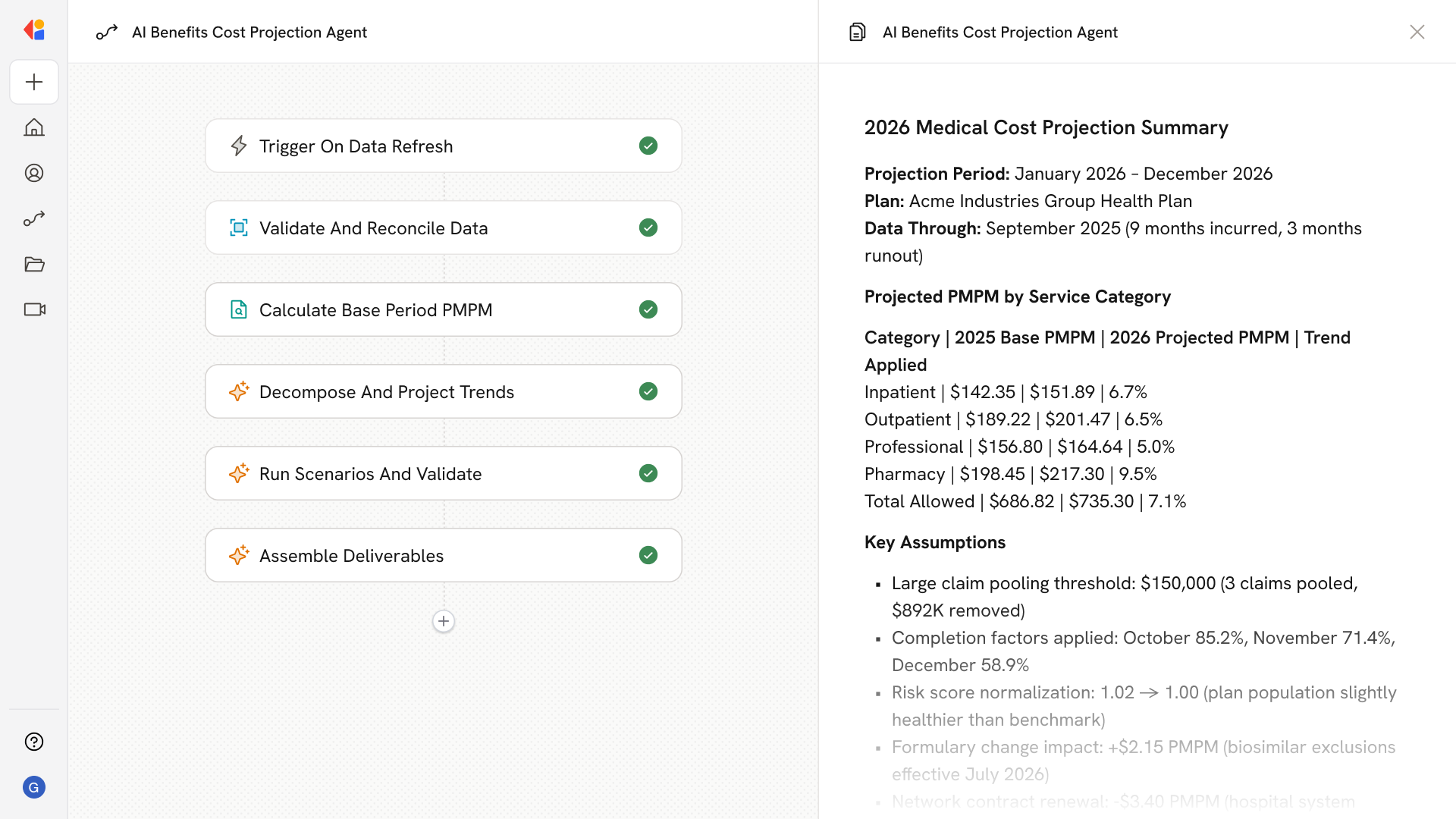

AI Contract Review Agent
Automating Insurance Contract Review with AI
Playbook-Driven Redlines in Minutes, Not Days
The agent applies your calibrated playbooks—required clauses, preferred language, acceptable fallbacks, and no-go positions—to automatically generate tracked changes that conform counterparty paper to your standards.
Compliance Gates That Catch What Humans Miss
Automated checks verify HIPAA BAA required elements, NAIC stop-loss attachment thresholds, ERISA claims procedure alignment, and producer anti-rebating provisions, flagging gaps before they become coverage disputes.
Cross-Document Alignment That Prevents Reimbursement Gaps
AI analysis detects misalignments between ASO agreements, plan documents, and stop-loss policies—catching definitional conflicts, run-out mismatches, and exclusion discrepancies that create costly coverage gaps.
How Cassidy automates this using AI
Step 1: Ingest and classify incoming contracts
The Workflow triggers when a new contract arrives—whether counterparty paper or carrier paper in Word or PDF. Cassidy automatically classifies the agreement type (ASO, BAA, producer, or stop-loss), detects exhibits like fee schedules and endorsements, and extracts key metadata including parties, jurisdiction, effective dates, and term.
Step 2: Apply playbook and clause library
Cassidy pulls from your Knowledge Base to retrieve the relevant playbook for that contract type, including required clauses, standard positions, acceptable fallbacks, and escalation triggers. The clause library provides approved templates and defined negotiation levers specific to benefits carrier agreements.
Step 3: Analyze and extract domain-specific terms
The AI performs deep extraction tailored to each contract type—services matrices and SLA metrics for ASO agreements, permitted PHI uses and breach timeframes for BAAs, commission schedules and appointment prerequisites for producer agreements, and attachment points, lasering, and mirroring terms for stop-loss policies.
Step 4: Generate automated redlines with rationale
Cassidy drafts tracked changes in Word to conform the contract to your playbook, swapping in approved clause language, adding required endorsements, and providing positioning notes that explain each change with fallback options for negotiation.
Step 5: Run compliance checks and risk scoring
Automated verification confirms all HHS-required BAA elements, checks stop-loss attachment points against NAIC thresholds, validates ERISA claims procedure incorporation in ASO agreements, and flags producer anti-rebating gaps—generating a risk score, heatmap, and "must fix before signature" list.
Step 6: Route for approval and track negotiation
Cassidy routes flagged issues to legal, compliance, underwriting, or privacy teams based on your approval thresholds. The system maintains version control, tracks counterparty concessions, and updates your clause library with accepted fallbacks to improve future automation.
Step 7: Finalize and create obligation register
Once approved, Cassidy generates clean and redline execution sets, collects required exhibits and certifications, and creates an obligation register with reporting deadlines, breach notice SLAs, renewal periods, and audit windows—with calendar entries for critical dates.
Implement it inside your company
- Hands-on onboarding and support
- Self-paced training for your team
- Dedicated implementation experts
- Ongoing use case discovery
- ROI tracking & analytics dashboards
- Proven playbooks to get started fast