
AI Technical Submittal Package Agent for Industrial Sealing Products
Automating Technical Submittal Packages for Industrial Sealing Products with AI
Standards-Driven Selection and Compliance
The agent encodes API 682 taxonomy and ASME PCC-1 calculations to propose seal arrangements, piping plans, and bolt/gasket configurations that meet project specs and regulatory requirements from the first submission.
Automated Document Generation
AI automation populates API 682 datasheets, generates plan P&IDs, produces GA drawings, and compiles IOM manuals—all aligned to client SDRL formats and document numbering requirements.
End-to-End Traceability and Review Management
The system tracks comment dispositions across review cycles, maintains revision control, validates certificate completeness, and builds final MRB/databooks with cross-referenced indexes ready for turnover.
How Cassidy automates submittals and compliance using AI
Step 1: Ingest RFQ and project specifications
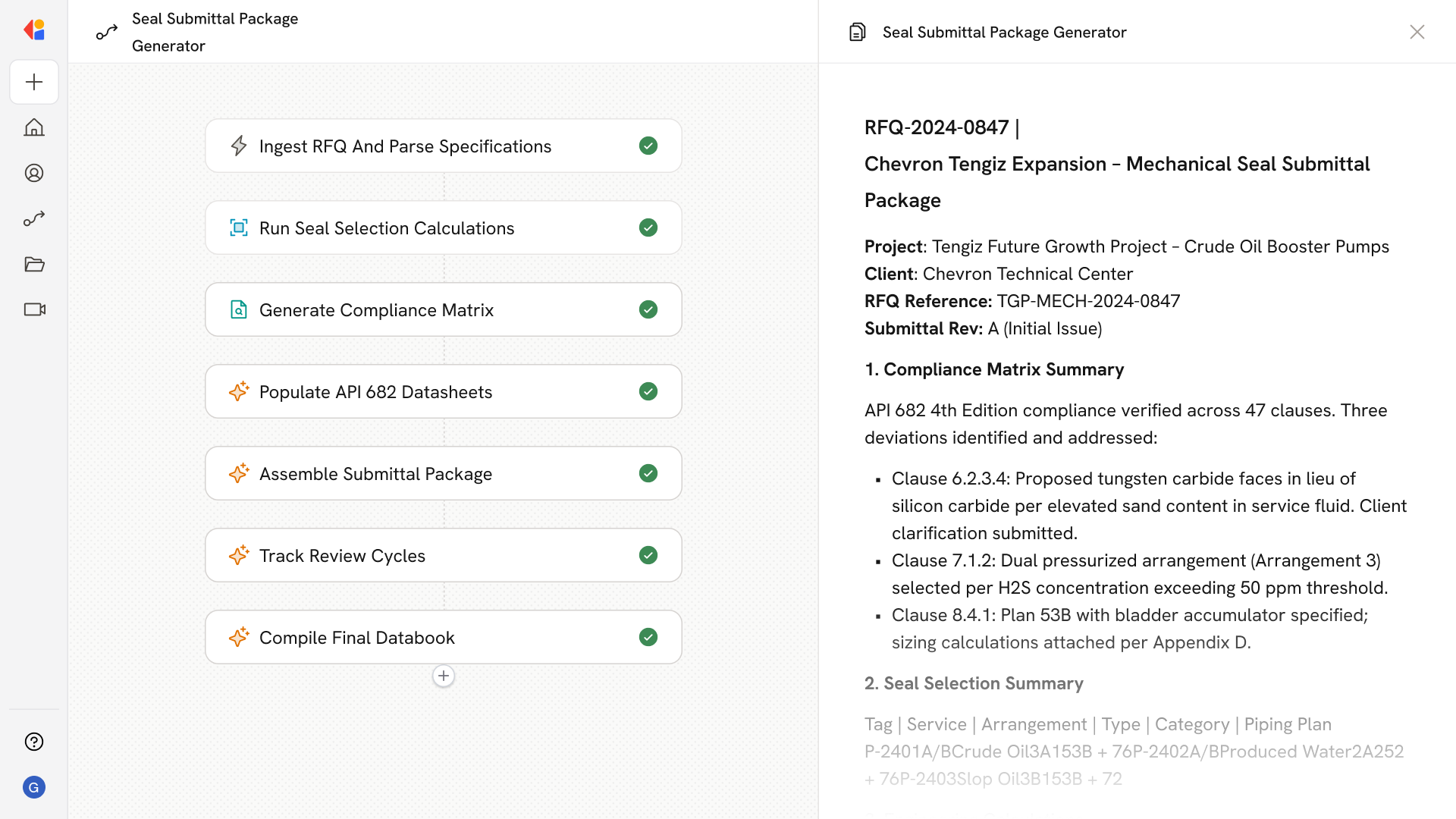
The Workflow triggers when a new RFQ arrives, automatically parsing client specs, piping classes, equipment datasheets, and service conditions to build a requirements matrix mapped against API 682, ASME PCC-1, and project-specific standards.
Step 2: Run seal selection and engineering calculations
Cassidy applies API 682 logic to determine the optimal arrangement, type, category, and piping plan set based on duty conditions. For flanged joints, it computes target gasket stress and bolt torque per PCC-1 tables.
Step 3: Generate compliance matrix and flag deviations
The Workflow auto-generates a clause-by-clause compliance matrix against API 682 and project specs, identifying gaps, proposing compliant alternatives, and preparing clarification responses.
Step 4: Populate submittal documents
Cassidy fills API 682 datasheets with service and selection data, generates plan P&IDs from selected plan codes, produces GA/section drawings, and creates IOM checklists—all formatted to client SDRL requirements.
Step 5: Compile and validate the submittal package
The Workflow assembles the complete package—drawings, datasheets, ITP/QCP, certificates, and PCC-1 assembly procedures—validating completeness against the SDRL index before generating a transmittal-ready PDF set.
Step 6: Manage review cycles and revisions
As client comments arrive, Cassidy tracks dispositions, propagates changes across drawings and BoMs, updates the document register, and maintains full revision history through approval.
Step 7: Build final MRB/databook for turnover
Once approved, the Workflow compiles the as-built databook with signed ITPs, test records, MTRs, certificates, and completed FJARs—bookmarked, cross-referenced, and validated for completeness before release.
Implement it inside your company
- Hands-on onboarding and support
- Self-paced training for your team
- Dedicated implementation experts
- Ongoing use case discovery
- ROI tracking & analytics dashboards
- Proven playbooks to get started fast