
AI Technical Inquiry Triage Agent for Motion Control Sales Operations
Automating Technical Inquiry Triage for Motion Control Sales with AI
Intelligent Intake and Specs Extraction
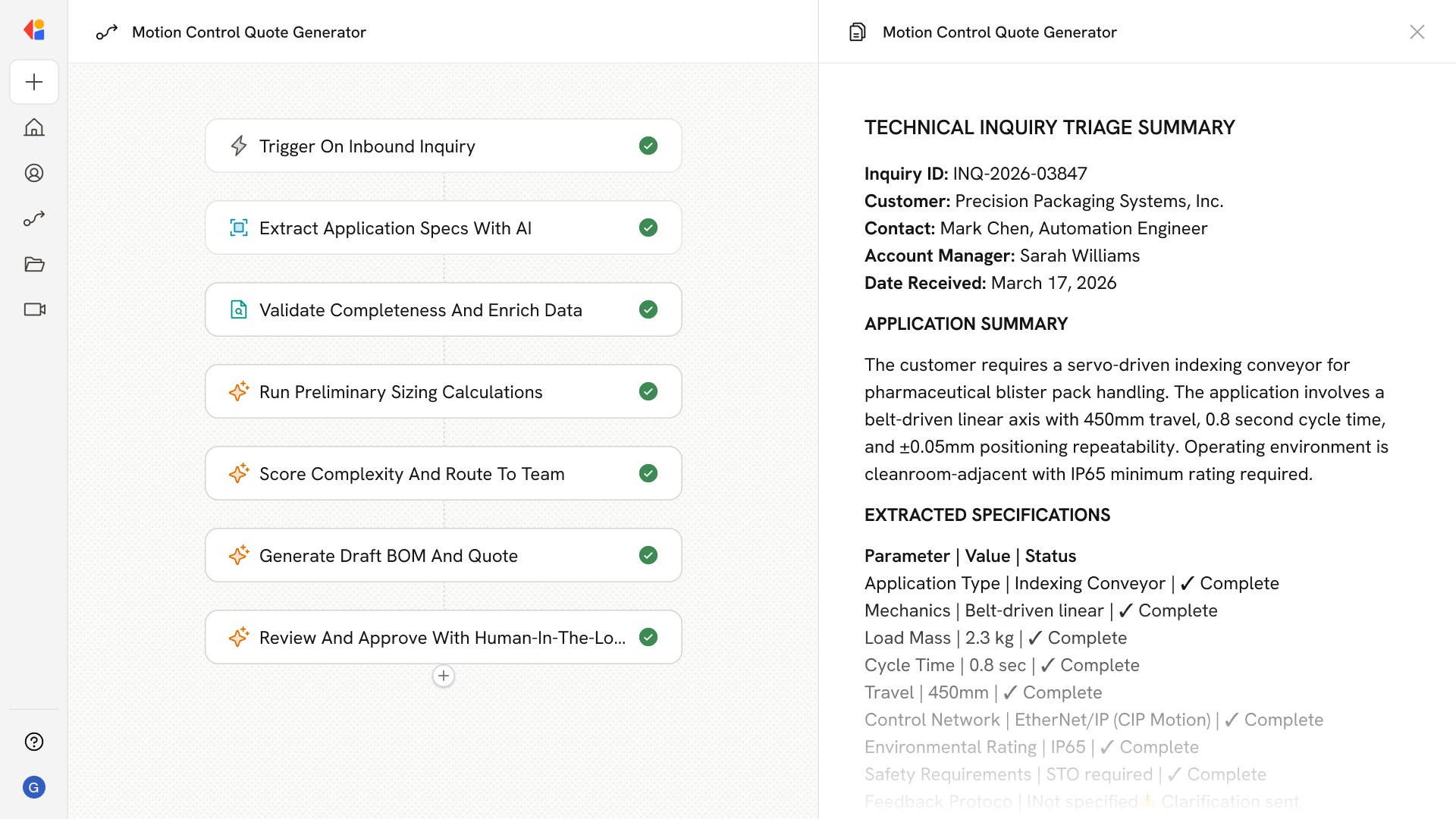
The agent parses inbound RFQs, emails, PDFs, and drawings to extract critical application data—load inertia, torque-speed requirements, motion profiles, bus voltage, control network, and environmental ratings—eliminating manual data entry and reducing back-and-forth.
Automated Qualification and Routing
Each inquiry is classified by type (RFQ, sizing request, cross-reference, support ticket), scored for complexity, and routed to the right team—inside sales for standard requests, applications engineering for safety-critical or high-inertia applications—with SLA timers and escalation paths built in.
Draft BOM and Quote Generation
Preliminary sizing calculations validate inertia ratios and torque-speed fit, then auto-generate a draft bill of materials with catalog numbers, cable sets, and accessories—plus a CPQ-driven quote with pricing tiers, approval routing, and lead times ready for human review.
How Cassidy automates using AI
Step 1: Trigger on inbound inquiry
The Workflow activates when a technical inquiry arrives—whether from email, web form, distributor portal, or CPQ system—and begins processing immediately.
Step 2: Parse and extract application specs
Cassidy analyzes the incoming request using AI to extract key parameters: application type, mechanics (ballscrew, belt, rack & pinion), load inertia, torque/force requirements, motion profile, duty cycle, bus voltage, control network (CIP Motion, Sercos, Profinet), feedback protocol, environmental ratings (IP65/67/69K), and safety requirements (STO, SIL2/PL d).
Step 3: Enrich and validate completeness
The Workflow cross-references extracted data against your application data sheet requirements, flags missing fields, and auto-drafts clarification questions for incomplete submissions while enriching contact and account information from your CRM.
Step 4: Pre-size and validate fit
Cassidy runs preliminary sizing calculations—computing reflected load inertia, checking continuous and peak torque against torque-speed curves, and recommending gear reduction or leadscrew options to optimize inertia ratio and motor selection for the customer's controls ecosystem.
Step 5: Score complexity and route
Based on application risk factors—safety functions, multi-axis interpolation, hygienic design, high-inertia loads—the Workflow assigns a complexity score and routes to the appropriate team: inside sales, applications engineering, or product management.
Step 6: Generate draft BOM and quote
Cassidy assembles a draft bill of materials with drive, motor/actuator, feedback cables, mechanical transmission, and accessories—applying CPQ pricing rules, discount tiers, and margin guardrails to produce a draft quote with lead times and approval routing.
Step 7: Human-in-the-Loop review
Applications engineering reviews sizing calculations and technical fit while sales validates commercial terms. The Workflow surfaces assumptions, open questions, and risk notes—then issues the final quotation once approved.
Implement it inside your company
- Hands-on onboarding and support
- Self-paced training for your team
- Dedicated implementation experts
- Ongoing use case discovery
- ROI tracking & analytics dashboards
- Proven playbooks to get started fast