
AI Customer Technical Response Agent for Safety Valve Sales Teams
Automating Customer Technical Response for Safety Valve Sales with AI
The agent reads customer RFQs and attachments—P&IDs, equipment datasheets, prior PSV sizing sheets—to extract mandatory inputs like set pressure, MAWP, back-pressure conditions, and fluid properties, then flags gaps requiring clarification.
Perform API 520 Sizing and API 526 Selection
Automated calculations apply the correct API 520 Part I equations with certified Kd, Kb, and Kc factors, determine the governing scenario per API 521, and select the appropriate orifice letter and valve configuration based on back-pressure type and service requirements.
Generate Sales-Ready Deliverables and Quotes
The system produces complete submittal packages—sizing calculation reports, datasheets, compliance statements, and configured quotes with pricing and lead times—ready for customer delivery without manual document assembly.
How Cassidy automates using AI
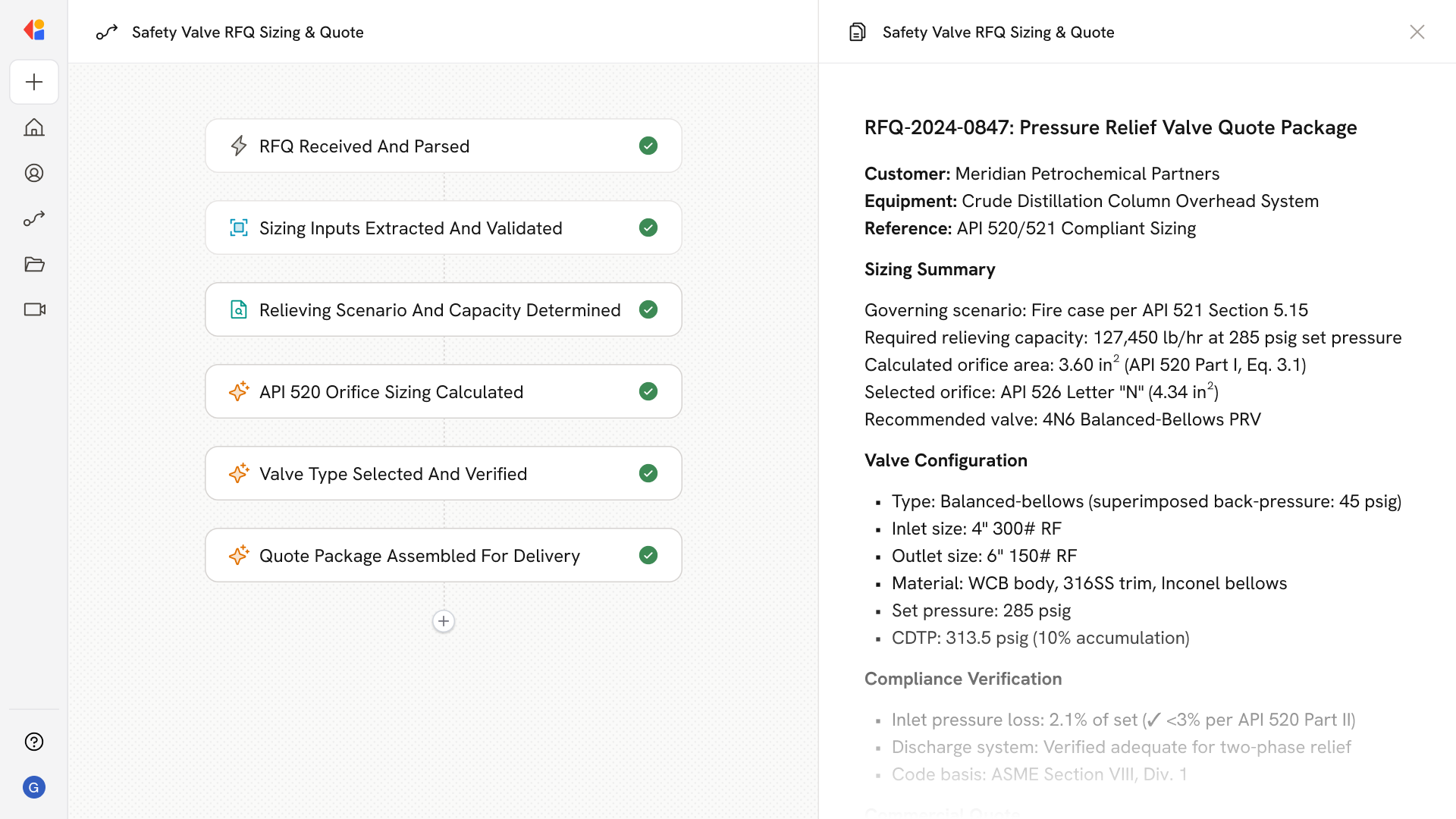
Step 1: Trigger on new RFQ receipt
The Workflow activates when a new RFQ arrives via email, web form, or CRM entry, pulling the request and any attached documents into Cassidy for processing.
Step 2: Extract and validate sizing inputs
Cassidy parses the RFQ and attachments to identify protected equipment, code basis (ASME/API/PED), process conditions, back-pressure details, and material requirements—automatically generating a clarification list for any missing or ambiguous data.
Step 3: Determine governing scenario and required capacity
Using API 521 methods, Cassidy identifies the worst-case relieving scenario (fire, blocked outlet, thermal expansion) and calculates the required mass flow at relieving conditions with the appropriate accumulation allowance.
Step 4: Perform API 520 sizing calculations
Cassidy applies the correct API 520 Part I formulas with manufacturer-certified coefficients, computes required effective discharge area, and selects the next larger API 526 orifice letter and valve size that meets capacity requirements.
Step 5: Configure valve selection and run mechanical checks
Based on back-pressure type and service conditions, Cassidy recommends conventional, balanced-bellows, or pilot-operated valves, then validates inlet pressure loss (≤3% of set) and discharge system constraints per API 520 Part II.
Step 6: Generate quote package and deliverables
Cassidy assembles the complete submittal—sizing calculation report, datasheet, compliance matrix, GA drawing reference, and configured CPQ quote with pricing, lead time, and terms—ready for review or direct customer delivery.
Implement it inside your company
- Hands-on onboarding and support
- Self-paced training for your team
- Dedicated implementation experts
- Ongoing use case discovery
- ROI tracking & analytics dashboards
- Proven playbooks to get started fast